Rooted in Purpose: How One Group is Making a Difference Through Tree Corps
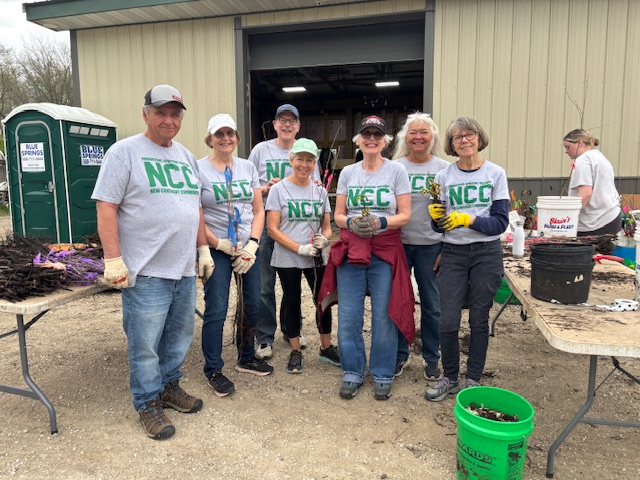
For the Green Team at Normal Community Church, volunteering with the Ecology Action Center’s Tree Corps program has become more than just a seasonal activity—it’s a deeply rooted tradition of environmental stewardship, community connection, and shared purpose.
Now in their fourth year being a Tree Team with the Tree Corps program, the group originally joined in search of a hands-on way to live out their church’s social justice values—especially the belief that caring for the planet is everyone’s responsibility. They were drawn to the accessibility of having Tree Teams which combines donations and volunteer labor and have found it to be a meaningful fit for their mission.
“We enjoy working outside with friends and the good feeling we get from doing something positive for the environment and our community,” they shared. “It’s tangible, fulfilling work—and we get to see the impact growing right in front of us.”
The Tree Corps initiative, which aims to plant 10,000 trees a year in McLean County for increased air quality, has also helped the group grow personally and collectively. The act of digging in the dirt, quite literally, has grounded them. “There’s something invaluable about getting your hands a little dirty and being part of something bigger than yourself,” they noted. “It’s brought our team closer and given us a renewed sense of purpose.”
In a time of environmental uncertainty and diminished federal support, the group believes local action is more important than ever. “Who's going to save the earth? It's got to be all of us,” they said. Supporting the EAC’s work is, to them, a small but powerful answer to that global call.
Have you checked BN Green Events lately? If so, you might have seen that the EAC is busy with lots of workshops and volunteering opportunities. Check out below all the cool things going on at the EAC!
·Storm Drain Stenciling: Assist the EAC in helping educate residents on storm water pollution by stenciling "Drains to Stream. Keep Clean" on neighborhood storm drain inlets and distributing informational door hangers on stormwater runoff pollution and strategies to reduce it. Stenciling is a great way to get the entire family outside and involved this summer.
·Sugar Creek Stewards: Help to improve Sugar Creek by clearing out invasive plant species and managing non-invasive plants in designated areas throughout Bloomington and Normal. This work improves stream buffers which help filter out stormwater runofff pollution and improve habitat for native pollinators. This volunteer opportunity occurs on the third Saturday of every month.
·Rain Barrel: Springtime means rain which means it is a great time to start collecting rain water to be used on your garden later in the season. This will put less strain on your wallet and on our municipal water systems. The EAC’s rain barrel workshops start in April and run through fall. Rain barrel workshops last about an hour and cost $55 ($45 for EAC Members). At the end of the workshop, you will have all the necessary tips, tricks, and tools to start harvesting rain water in your very own rain barrel!
·Backyard Composting: It is planting season for central Illinois. It might be too late to make your own compost for this planting season but it is a great time to start your pile to put on next year’s garden. The EAC’s backyard composting workshops run spring to fall and cost $35 ($25 for EAC members) for the workshop and compost bin and $110 for the workshop, compost bin, stirrer, and thermometer.
·Vermicomposting: Wanting to make compost in time to put on your fall crops? Try vermicomposting! Similar to backyard composting, vermicomposting uses red wiggler worms to produce compost fast in the comfort of your own home. The EAC’s vermicomposting workshops run spring to fall and cost $35 for the workshop and vermicomposting bin with hundreds of your new worm friends.
·Tree Planting with Friends of the Constitution Trail in Chenoa: May 16, 2025: Volunteers will use shovels and other tools to plant root-ball sapling trees – 6-8 feet tall. Volunteers must be 18 years old or older or alternately 12 years or older and accompanied by a parent or legal guardian.
·Illinois Prairie Wild Ones Native Plant Sale: May 17, 2025:Available for sale will be a variety of central Illinois native plants that will provide blooms for the entire growing season! These plants will help support hummingbirds, bees, butterflies and more.
Yard Smart Spring Ephemerals
Spring ephemerals are short-lived wildflowers that signal the arrival of spring. These delicate plants complete their life cycle in early spring—before trees and shrubs leaf out and block sunlight. They play a crucial role in supporting pollinators emerging from winter hibernation. With the right conditions, Yard Smart gardeners can plant these beauties and enjoy them for years to come.
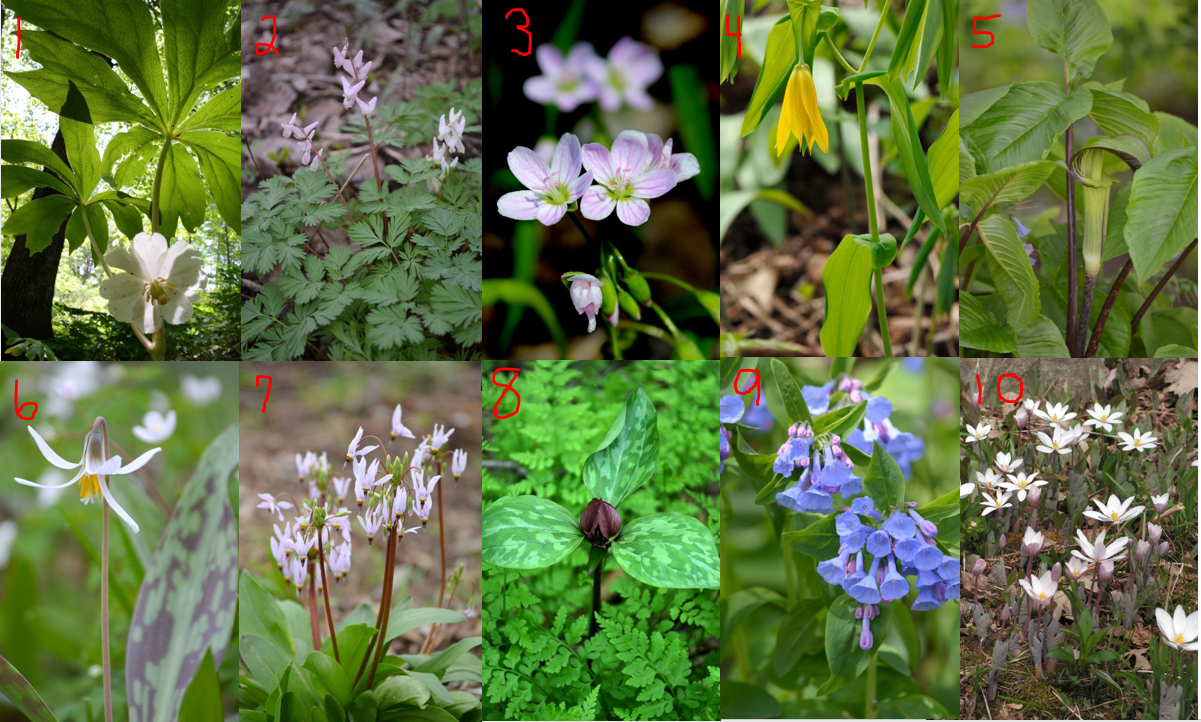
Try to match the descriptions below to the corresponding flower images! (Answers can be found at the end of the newsletter!)
·Blood Root: This plant has two distinct stages. For a brief time in early spring, it displays a striking white blossom with a scent that attracts pollinators. A leaf is wrapped around the flower’s stem; once the bloom fades, the leaf unfurls.
·Midland Shooting Star: Named for the cluster of dramatic flowers it produces, this plant showcases blooms ranging from purple to pale pink to nearly white.
·Spring Beauty: A favorite among pollinators, this resilient flower thrives even in degraded habitats. From a distance, it appears pale pink, but up close you’ll see five white petals delicately striped with pink.
·Prairie Trillium: No taller than 12 inches, this plant has a central stem that fades from reddish purple to light green. In the center, a single red, 3 petaled, flower with downward facing green sepals can be found. This plant is very slow growing as it can take 10 years to produce flowers.
·White Trout Lily: Often found growing in colonies, this plant produces a single flower that blooms for just a few days. Its tulip-like green leaves are marked with silvery-maroon mottling. Research shows that this plant acts as a nutrient pool for nearby forest plants.
·Large-flower Bellwort: Ideal for shady areas, this plant spreads slowly through rhizomes. It has a distinctive droopy appearance when in bloom and thrives in well-drained, average soil.
·Dutchman’s Breeches: Named for its unique bloom that resembles a pair of white breeches hanging upside down, this plant develops fern-like leaves after flowering.
·Jack-in-the-Pulpit: The “Jack” refers to the spongy cylindrical structure whereas the “pulpit” is the leaf-like structure that is rolled into a deep cup with an overhanging roof.
·Virginia Bluebells: One of the most recognizable native ephemerals, these flowers start pink and mature into their signature blue. Only the largest bees can access their tubular blooms, making butterflies and moths their main pollinators.
May Apple: You’ve likely seen their large, umbrella-like leaves, but peek underneath and you’ll find a beautiful white flower that blooms in May and June. Though aggressive, Mayapples are a great option for dry, semi-shady conditions.
The Illinois EPA has announced their spring schedule of Household Hazardous Waste (HHW) collection events including an event in Peoria on May 31, 2025. Registration for an appointment is required. All Illinois EPA sponsored HHW collection events are open to ALL Illinois residents bringing residentially-generated hazardous wastes. Business waste is prohibited by law.
As usual, the Ecology Action Center is working towards a possible fall Household Hazardous Waste collection event in McLean County and will send updates once the IEPA announces that or other events scheduled for fall 2025. For HHW updates please subscribe to our McLean County Household Hazardous Waste Email Updates Newsletter.
Plastic Resin Codes are NOT for Recycling
By: EAC Intern Hadley McKenzie
What are Resin Identification Codes (RICs)?
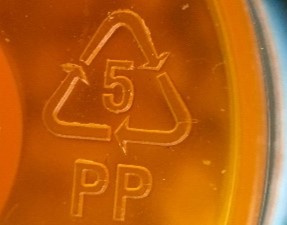
Resin Identification Codes (RICs) were developed in 1988 by the plastics industry.[1] RICs are found on the bottoms or backs of plastic items and include a number 1-7 inside a triangle. In 2013, ASTM International (an international product quality, safety, and trade organization that maintains the RIC system) replaced the original ‘chasing arrows’ triangle (see Figure 1) with a bolded solid triangle to reduce confusion that the symbol should be associated with recycling; manufacturers aren’t required to change their equipment though, so many still use the chasing arrows which leads to public confusion and increased recycling contamination.1, [2]
Numbers 1-6 all represent a specific type of resin, with number 7 indicating ‘other.’ Plastic resins each have individual qualities that make them suitable for certain projects; for example, RIC #1 (polyethylene terephthalate or PET) is best used for water, soda, and condiment bottles, but RIC #2 (high-density polyethylene or HDPE) is better for milk, juice, detergent, and shampoo bottles. RIC #4 (low-density polyethylene or LDPE) is good for plastic film and squeeze bottles, but RIC #3 (polyvinyl chloride or PVC) is best for plumbing pipes and kid’s toys.[1]
Why are RICs not useful to the public?
In short, RICs were not designed and never intended to be for public use. They were initially created to help plastic manufacturers when designing products; for example, if they knew that a product needed similar packaging qualities as a soda bottle, RICs were a shortcut for manufacturers to know that they should try RIC #1. Recycling facilities also benefitted from the codes, as it was a way to reduce employees having to test, guess, or assume what a product was made of before trying to sort and recycle the material.
Since 1988, RICs have been noticed and misinterpreted by the public, and in some cases incorrectly taught, that they are a sign that a product can be recycled. In reality, most (but not all!) of these plastics are not yet recyclable in most communities. When the public places non-recyclable products into recycling bins, it contaminates the recycling which leads to an increased price for recycling because there is more sorting, labor, time, and tools involved trying to pick out the non-recyclable items.
What should we use instead of RICs?
When deciding whether or not a plastic product is recyclable, it is best to refer to your local recycling guides and regulations as each recycling facility is unique. What can be recyclable in one county may not be in another. In McLean County, plastic bottles, jugs, tubs, and jars are recyclable whereas other shapes like clamshells, containers, and cups are not. Bloomington, Normal, and McLean County recycling guide(s) for plastics and other products can be found at RecycleBN.org.
.png)