Illinois Must Lead on Wetland Protection to Safeguard Our Water Future Guest Editorial by Timothy L. Erwin, Executive Director of the Bloomington and Normal Water Reclamation District
Wetlands are among Illinois’ most valuable natural assets. They purify our water, reduce flood risks, recharge groundwater, and provide critical habitat for hundreds of species. Yet, Illinois has lost nearly 90% of its original wetlands — one of the highest loss rates in the nation—due to decades of development, drainage, and neglect. This loss has profound consequences for water quality, biodiversity, and climate resilience.
Recent federal court decisions have rolled back protections for many wetlands under the Clean Water Act, leaving them vulnerable to pollution and destruction. Without strong state-level safeguards, Illinois risks further degradation of these vital ecosystems. The time has come for Illinois to establish a comprehensive Wetland Protection Program—one that recognizes wetlands as essential infrastructure for clean water, flood control, and ecological health.
Our state’s aging water infrastructure is under increasing strain from population growth, climate change, and extreme weather events. Traditional “gray” infrastructure alone cannot meet these challenges. Green infrastructure—such as restored wetlands, rain gardens, and permeable surfaces—offers a cost-effective, sustainable solution. Wetlands naturally filter pollutants like phosphorus, nitrates, and sediment, reducing the burden on wastewater treatment facilities and improving downstream water quality.
The environmental and economic benefits of wetlands are well-documented. They support robust ecosystems, sequester carbon, and provide recreational opportunities. They also contribute to economic stability by reducing disaster recovery costs and supporting local jobs in conservation, construction, and tourism. According to the Value of Water Campaign, every $1 invested in water infrastructure generates nearly $4 in economic returns.
A compelling example of wetland success can be found in McLean County, where the Bloomington and Normal Water Reclamation District constructed 25 acres of wetlands to treat effluent from the Southeast Wastewater Treatment Facility. These wetlands have historically shown to reduce phosphorus levels by 50% and nitrates by 90%, demonstrating the power of nature-based solutions. Plans are now underway to restore these wetlands and protect the biodiversity of Little Kickapoo Creek.
To replicate this success statewide, Illinois must lead with vision and coordination. A state-level Wetland Protection Program would align efforts across municipalities, agricultural stakeholders, environmental organizations, and residents. It would provide technical assistance, funding, and policy support to restore and protect wetlands, while integrating them into broader water and climate resilience strategies.
Protecting wetlands is not just an environmental imperative — it’s a public health, economic, and moral one. As Mahatma Gandhi once said, “The earth, the air, the land, and water are not an inheritance from our forefathers but on loan from our children.” Let us honor that responsibility by investing in the natural infrastructure that sustains us all.
Get Involved For Earth Month
Have you checked BN Green Events lately? If so, you might have seen that the EAC is busy with lots of workshops, programs, and volunteering opportunities to celebrate Earth Day. Check out below all the cool things going on at the EAC!
YARD SMART WORKSHOPS
Rain Barrel: Spring time means rain which means it is a great time to start collecting rain water to be used on your garden later in the season. This will put less strain on your wallet and on our municipal water system. The EAC’s rain barrel workshops start in April and run through fall. Rain barrel workshops last about an hour and cost $60 ($50 for EAC Members). At the end of the workshop you will have all the necessary tips, tricks, and tools to start harvesting rain water in your very own rain barrel! Visit ecologyactioncenter.org/workshops to sign up.
Backyard Composting: It is getting to be planting season for central Illinois. It might be too late to make your own compost for this planting season but it is a great time to start your pile to put on next year’s crops. The EAC’s backyard composting workshops run spring to fall and cost $35 ($25 for EAC members) for the workshop and compost bin and $110 for the workshop, compost bin, stirrer, and thermometer. Visit ecologyactioncenter.org/workshops to sign up.
Vermicomposting: Wanting to make compost in time to put on your fall crops? Try vermicomposting! Similar to backyard composting, vermicomposting uses red wiggler worms to produce compost fast in the comfort of your own home. The EAC’s vermicomposting workshops run spring to fall and cost $35 for the workshop and vermicomposting bin with hundreds of your new worm friends. Visit ecologyactioncenter.org/workshops to sign up!
PROGRAMS!
Central Illinois 2026 City Nature Challenge, April 24-April 27: Cities around the world, including McLean County, will be using the iNaturalist app to find, photograph, and identify as many wild plants, animals, and fungi in order to remind folks that urban nature is still nature. Learn more and participate at citynaturechallenge.org
International Compost Awareness Week Programs, May 4-9: Learn about commercial, backyard, and vermicomposting in these hour-long programs available at the listed McLean County libraries. Registration may be required, please visit the libraries website to learn more. Mt. Hope Funks Grove Library, May 6 from 6:00-7:00pm
Rivian 5K, May 9 (10:30am): Join the Ecology Action Center at the fourth annual Rivian 5k (or 1 mile walk) at Heartland Community College. Proceeds support the Ecology Action Center and Friends of the Constitution Trail. Sign up at runsignup.com/Race/IL/Normal/Rivian5k
Illinois Prairie Wild Ones Native Plant Sale, May 16 (8:00-1:00pm): Available for sale will be a variety of central Illinois native plants that will provide blooms for the entire growing season! These plants will help support hummingbirds, bees, butterflies and more. More information and a tentative list of plants for sale is available at illinoisprairie.wildones.org/nativeplantsale/
VOLUNTEERING!
Tree Corps: Tree-Corps is the EAC’s initiative to plant 10,000 trees in McLean County annually. Tree Corps prep and planting days are happening most Fridays, Saturdays, and Sundays in April and early May. Check out Tree-Corps.org for more specifics and to sign up to volunteer.
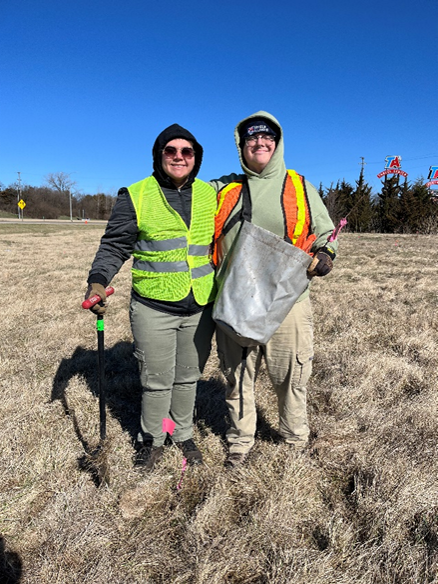
Earth Day Constitution Trail and Sugar Creek Clean Up: On April 25 from 9-12pm help pick up trash around Sugar Creek with the Ecology Action Center and friends of the Constitution Trail. Trash pickup will be happening on the trail from the Chateau west to Audubon Gardens. All participants must sign up individually at https://ecologyactioncenter.org/volunteering
Sugar Creek Stewards: Help to improve Sugar Creek by clearing out invasive plant species and managing non-invasive plants in designated areas throughout Bloomington and Normal. This volunteer opportunity occurs on the third Saturday of every month. Learn more and sign up at https://ecologyactioncenter.org/volunteering
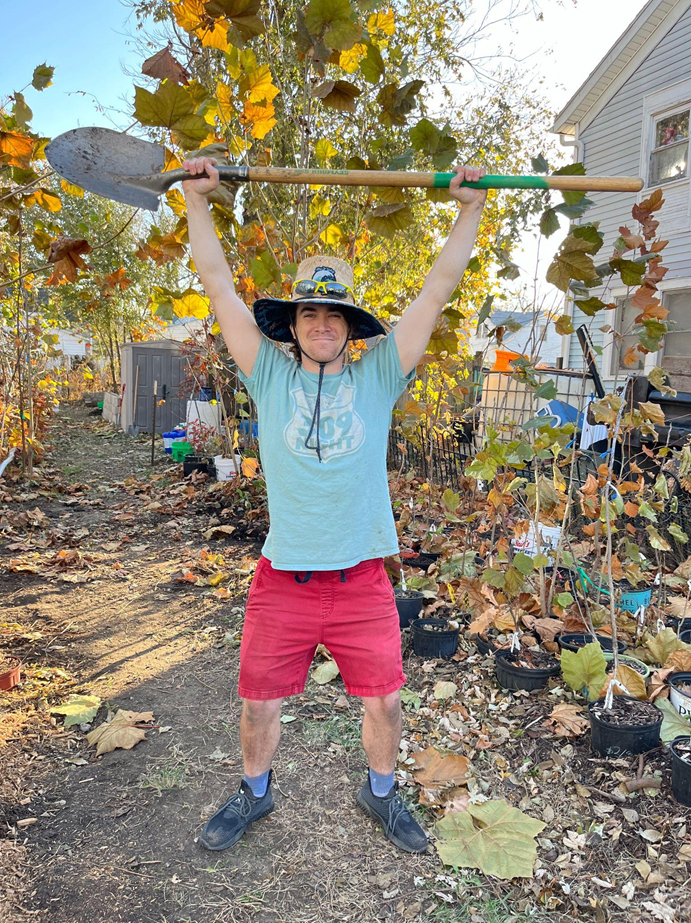
Volunteer Highlight: Nathan Flatley
I volunteer with the Ecology Action Center Sugar Creek Stewards and Tree Corps because caring for our environment is something I care about at a fundamental level. Protecting and improving the place we all call home isn’t just rewarding — it’s a shared responsibility we carry as members of this community. Whether we’re planting trees, cleaning up litter, or removing invasive species, this work strengthens our community’s long-term ecological health and reflects the kind of future we want to build together. I’m grateful to stand alongside people who take that responsibility seriously, and for anyone who wants to give back but isn’t sure how, this is a meaningful and welcoming place to start.
Law of the Lamp: What to Know About New Fluorescent Lamp Legislation in Illinois
Who knew something as simple as lighting would make it to the floor of the State Capitol? That’s exactly what happened in August 2024, when Illinois enacted a statewide ban on most fluorescent lamps containing mercury, known as the Clean Lighting Act (Public Act 103-0799). While it’s been over a year since this bill first passed, key deadlines in the bill are beginning to arrive. As of January 1, 2026, retailers could no longer sell screw/bayonet-based CFL bulbs. By January 1, 2027, this ban will expand to include pin-base CFLs and most tube lights (T5, T8, T10, T12).
If you already have CFLs installed in your home or business, then the bill still allows them to be used until they burn out. But once they do, you may be asking: What happens now? Where do I dispose of them, and what can I replace them with? In this article, we will explore what makes fluorescent lamps hazardous, how to properly dispose of them, and what alternatives you can use that will lead to significant savings on energy.
What makes fluorescent lamps hazardous?
Fluorescent bulbs contain a small amount of mercury in the glass tubing. While the bulb is intact and functioning, this mercury is not a threat. However, a bulb is likely to break either when it is thrown away, in the process of getting to a landfill, or after being dumped in a landfill. When the bulb breaks, the mercury is no longer contained and is released as a vapor into the atmosphere. This vapor is what contributes to human and wildlife exposure and environmental mercury pollution.
To humans, mercury can have toxic effects on the nervous system, the digestive system, and the immune system, even in small amounts. While there is not enough mercury in a single bulb to cause these effects, it is estimated that three out of four fluorescent bulbs are disposed of improperly and release mercury into the environment. Impacts from improper disposal add up quickly, and it is projected that the Clean Lighting Act’s ban on the selling of CFL bulbs in Illinois will eliminate 490 pounds of mercury pollution by the year 2050.
How do I safely dispose of fluorescent lamps?
In the Bloomington-Normal area, Echo Electric (902 Four Seasons Rd.) and Lowes (2101 E Empire St.) are both drop-off locations for CFL bulbs. However, only Echo Electric is able to accept tube fluorescents. Due to the mercury content in these bulbs and the impacts previously mentioned, proper disposal of CFL products is important to prevent mercury pollution and protect public health.
What’s the best alternative to fluorescent lamps?
The best alternative to fluorescent lamps are LED bulbs and tubes. LEDs offer an array of benefits over fluorescent lamps, the first being safety. LEDs contain no mercury and are considered non-toxic. If they do break they require no hazardous cleanup procedures. LEDs also last longer than fluorescents, with a lifespan of between 30-50,000 hours given typical residential usage. But LED’s biggest advantage is their efficiency. On average, LEDs use half the amount of energy as fluorescents, and the Department of Energy estimates that the average household can save $225 annually on lighting costs by switching to LEDs. While their upfront cost is higher than other bulbs, LEDs provide higher long-term savings on energy that even out that cost. Combined with their safety and durability, LEDs are the easy choice for home and business lighting needs.

.png)